Masculinity and Physical Size
The Shrinking ManMasculinity and Physical Size describes how Scott Carey’s progressive shrinking unsettles not only his bodily self-image but also the social roles through which he has understood himself as a man. His plans for economic security, his marriage to Louise Carey, and his authority as Beth Carey’s father all depend, in different ways, on a position that shrinking steadily makes harder to maintain. The novel’s central tension is that Scott’s needs and relationships persist even as his physical presence—and the recognition attached to it—dwindles.
Security and the Provider Role
Before his condition disrupts his plans, Scott imagines building a stable life for his family through a sequence of practical achievements. He intends to work for Marty, apply for a GI loan with the possibility of becoming a partner in Marty’s business, and obtain life and medical insurance. A bank account, a decent car, clothes, and eventually a house belong to the same project: a structure of security around himself and his family. These aims define masculinity here through responsibility and provision as well as through physical strength. Scott’s concern is not simply that his future will change; the illness threatens the material plan by which he hopes to protect those closest to him.
The threat makes ordinary financial preparation newly uncertain. Scott had treated insurance and work as parts of a coherent future, but shrinking interrupts that sequence and imperils the security it was meant to establish. Later, family finances become an immediate pressure: Louise Carey says that fifty dollars a week is not enough to feed, clothe, and house the household. The contrast between Scott’s former ambition to build a secure home and the family’s later difficulty meeting expenses shows how his physical change coincides with a loss of confidence in his role as provider. The evidence does not reduce his distress to money alone; rather, financial responsibility is one concrete part of the larger identity his condition places under strain.
Marriage, Intimacy, and Changed Scale
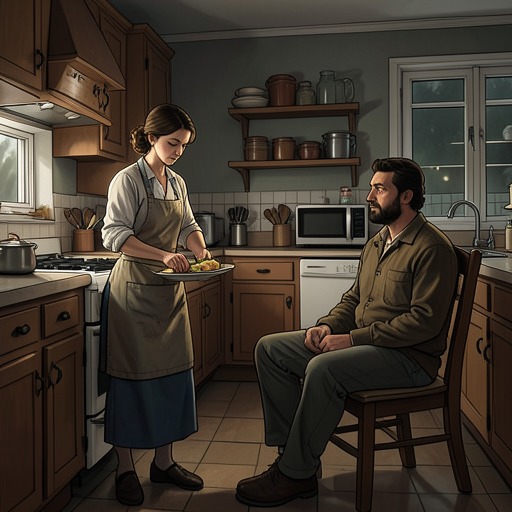
Shrinking alters the ordinary physical details of Scott and Louise Carey’s marriage. He has removed his wedding ring because his finger became too thin, leaving a pale band where it had rested. The ring registers a bodily change within an emblem of the marital relationship: their commitment remains, but his body no longer fits the object that marked it. In another domestic moment, Louise Carey is knitting a sweater for Beth Carey while Scott watches her. When he rests his cheek against her shoulder, he experiences the gesture as making him seem like a boy leaning on his mother. The discomfort arises from a collision between marital closeness and the increasingly childlike role his changed scale appears to impose on him.
That collision also reshapes how Scott reads his wife’s affection. When Louise Carey responds to his distress with tenderness, he interprets her manner as loving pity rather than the desire of a wife who wants him as a husband. The distinction matters because his need for intimacy has not disappeared along with his size. Yet he feels physically diminished beside her, and even the weight of her arm across his shoulders is difficult for him to admit is uncomfortable. Their relationship is therefore strained not by a single separation but by repeated adjustments in shared life, each making his former place beside her less secure.
Scott later tries to explain that he still needs companionship, affection, and love, and asks Louise Carey to understand his wish to spend one night with another woman. He stresses that her trailer has furniture suited to his size, including a chair in which he can sit as a man rather than feel reduced to something less. The request joins emotional need to an ordinary question of physical accommodation. His appeal makes clear that the crisis is not only about whether he can perform a conventional masculine role; it is also about whether anyone will make room for him to inhabit adult dignity at all.
Fatherhood and Physical Authority
The theme becomes especially explicit in Scott’s relationship with Beth Carey. The narrative explains that a child’s perception of a father depends partly on physical difference: Scott had been six feet two inches tall while Beth Carey was four feet one inch. His height and deeper voice had contributed to the impression of strength and authority associated with fatherhood. The account does not present that authority as something he deliberately established through intimidation. Instead, it describes a familiar imbalance of scale that helped make him seem dependable and powerful to a young child.
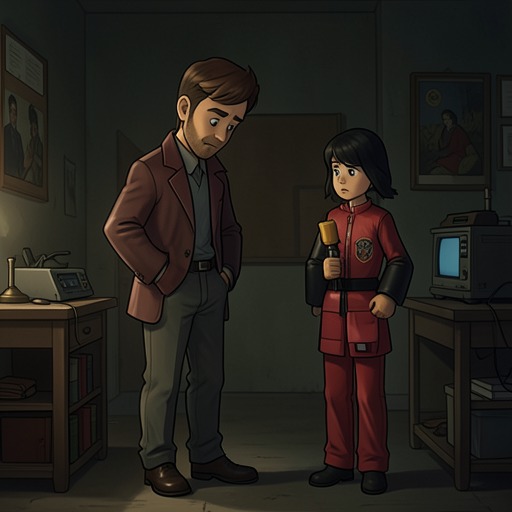
As Scott shrinks to Beth Carey’s height and then below it, that visible difference disappears. His voice also loses its former depth, and Beth Carey cannot make sense of a father who changes so radically. Scott and Louise Carey try to explain the condition to her, but she has no comparable experience through which to understand it. Because she expects a father to remain constant, the altered body unsettles her recognition of him. Her respect wanes, and Scott’s outbursts, which Beth Carey cannot interpret with adult sympathy, make him appear to her as an oddity rather than as the father she once knew.
Scott’s protests reveal how strongly he experiences this change as a loss of paternal identity. He insists that he is not a boy and remains Beth Carey’s father, even as his body and voice invite others to treat him as childlike. The statements are not proof that he has ceased to be a parent; they express the gap between his continuing sense of responsibility and the authority his family can still perceive. His recurring retreat to the cellar after angry episodes shows the personal consequence of that gap: the family relationship continues, but Scott finds it increasingly difficult to occupy his old place within it.
Recognition, Dependence, and the Meaning of Size
Louise Carey’s changing responses sharpen the contrast between Scott’s former stature and his present treatment. At one point he recalls being over six feet tall and finds himself smaller than his five-year-old daughter, dressed in little-boy’s clothes while his wife sounds faintly bored. What shocks him is not simply that she has stopped reacting with the same alarm. Her familiarity with his condition makes his altered status seem ordinary to her, while he still experiences it as a profound rupture. His identity as husband persists internally, but the everyday signs by which he once recognized that identity no longer secure it in the eyes of his family.
The novel thus presents size as both physical fact and social measure. Scott’s shrinking affects what he can manage, how others address him, and whether they readily recognize him as an adult man, husband, or father. His family’s responses are not identical: Louise Carey’s anxious care and Beth Carey’s limited understanding arise from different relationships and capacities. Still, both relationships expose the difficulty of preserving familiar roles when Scott’s body continually changes. His insistence on dignity coexists with dependence on others for forms of accommodation that once would have seemed unremarkable.
Narrative Significance
The theme gives the shrinking condition a domestic and relational significance beyond its effects on Scott alone. The novel tracks the way physical change enters a family’s routines: insurance plans and household finances, a ring that no longer fits, a sweater made for a child, a shared couch, and the differences in height and voice through which a father is recognized. These concrete details show masculinity not as an attribute guaranteed by Scott’s former size but as a position sustained through work, intimacy, authority, and mutual recognition.
At the same time, Scott’s persistent claims—to remain a husband, to remain a father, and to need companionship—complicate any equation between bodily scale and personal worth. His shrinking makes his social authority precarious, but it does not erase his attachments or adult desires. The tension between those continuing inner claims and the increasingly childlike treatment he receives is the theme’s decisive force: the body changes faster than the relationships and identities built around it can be renegotiated.